
French Rental Income Tax 2026: Everything Landlords Need to Know (Revenus Fonciers & LMNP)
April is landlord-tax month in France. Online filing opens on 9 April 2026, and private landlords must decide — often in a hurry — between the flat-rate micro-foncier regime and the far more flexible régime réel, collect a year's worth of invoices and receipts, and, for furnished rentals, pick between micro-BIC and LMNP régime réel. The 2026 season also brings real changes: social contributions on furnished (LMNP/BIC) rental income jump to 18.6% from 2025 income (a CSG increase confirmed in the 2026 Social Security Finance Law) — unfurnished revenus fonciers stay at 17.2% —, the doubled €21,400 déficit foncier cap for energy-performance works has been extended, and [DPE](/en/blog/2026-04-26-dpe-diagnostic-performance-energetique-2026) rules keep tightening — class G has been off the rental market since January 2025 and class F follows in January 2028. This guide is practical, grounded in official rules, and aimed at individual bailleurs declaring unfurnished (revenus fonciers) or furnished (BIC/LMNP) rental income. It does not cover SCI à l'IS. Use the checklists, deadlines and régime-comparison sections below to file with confidence — and to avoid the mistakes that trigger the most reassessments.
1. Who this guide is for
This article is written for individual landlords — bailleurs particuliers — who own French rental property in their own name. It covers the two main regimes an individual encounters: - Unfurnished rental (location nue), which generates revenus fonciers declared under the micro-foncier or régime réel track. - Furnished rental (location meublée), which generates BIC income and, for most individuals, falls under the LMNP regime (Loueur en Meublé Non Professionnel) — either micro-BIC or régime réel simplifié. It is not for: - SCI à l'IS (société civile immobilière subject to corporate tax), which files its own liasse and is outside the individual regimes described here. - LMP (Loueur en Meublé Professionnel) other than by passing mention — LMP status changes social-security affiliation and IFI rules and usually warrants professional advice. - Pinel, Denormandie, Loc'Avantages or Malraux specific schemes, which layer additional rules on top of the base regime. If you own rental property in your personal name and declare on formulaire 2042, this guide applies. If you are unsure whether your SCI is à l'IR or à l'IS, check your Kbis and the SCI's founding documents — à l'IR means each associate declares their share on their own 2044; à l'IS is a different world. Non-resident landlords (foreign tax residents with French rental property) follow the same regime logic but file to the Service des Impôts des Particuliers Non-Résidents and face the non-résidents online deadline (21 May 2026). Article 53 of the 2026 Finance Law clarified some LMP rules for non-residents — see section 3. If you are an expat who moved to France in 2025 and also happen to be a landlord, the income-tax side of your declaration (worldwide income rules, form 2047, box 8TK, partial-year split) is covered in ExpatAdminHub's French tax declaration 2026 guide for expats — read that alongside this guide to map both sides of your filing.
2. Micro-foncier vs régime réel (unfurnished rental)
For unfurnished rental income, the choice is binary and should be made on the numbers, not out of habit. Micro-foncier applies automatically when your gross rental income is below €15,000 per year and you do not own property under a specific scheme (Malraux, monuments historiques, etc.). You simply report the gross rents in box 4BE of form 2042 — no sub-form, no invoices to attach. The tax office then applies an automatic 30% flat-rate abatement, and the remaining 70% is added to your global taxable income. Régime réel is mandatory above €15,000 gross and optional below. You file form 2044 (or 2044-SPE for specific schemes), deducting actual charges from actual rents. The commitment is three years: if you opt in below €15,000, you cannot switch back to micro-foncier for three tax years. The critical lever: déficit foncier. If your deductible charges exceed your rents, the resulting foncier loss is deductible from your global income up to €10,700 per year, with the balance carried forward onto future rental income for up to 10 years. Interest on loans is not eligible for global-income offset — only the non-interest portion of the deficit is. For 2026, the doubled cap remains in force: when the deficit arises from works that improve the property's DPE class (for example from E to D, or from F to E before the 2028 ban), the deductible ceiling against global income is raised from €10,700 to €21,400 per year. The measure originally introduced to accelerate energy renovation has been extended — factor it in if you are weighing insulation or heating-system works before filing. Which regime to pick? As a rule of thumb, if your deductible charges exceed roughly 30% of gross rents — typical after any significant works, or with a recent loan — régime réel beats micro-foncier. Run the numbers both ways before clicking submit.
3. LMNP: micro-BIC vs régime réel simplifié
Furnished rental income is taxed as BIC (bénéfices industriels et commerciaux), not revenus fonciers. For most individuals, it falls under the LMNP regime, with two sub-regimes. LMNP micro-BIC applies when your gross furnished-rental income is below €77,700 per year (2025 income declared in 2026; the ceiling rises to €83,600 for 2026–2028 income under the Loi de finances 2026). A flat 50% abatement is applied automatically; you report the gross rents in box 5NI of form 2042-C PRO (new box numbering for the 2026 season, formerly 5ND). No book-keeping. Major change for 2026 filings: the Loi Le Meur (law no. 2024-1039 of 19 November 2024) cut micro-BIC thresholds for tourism rentals from 2025 income. Classified tourism rentals drop to €77,700 / 50% abatement (down from €188,700 / 71%), and non-classified tourism rentals to €15,000 / 30% abatement (down from €77,700 / 50%). Classic long-term furnished rentals (tenant's primary residence, lease ≥ 1 year) keep the €77,700 / 50% regime. If you run short-term Airbnb without a meublé-de-tourisme classification, check that your 2025 revenue stays under €15,000 before remaining on micro-BIC. LMNP régime réel simplifié lets you deduct actual charges and amortise the property, furniture and fit-out — often reducing taxable BIC income to near-zero for years. You file a liasse 2031 + 2033 (simplified) alongside your 2042-C PRO. Because it involves accounting depreciation schedules, most individuals under this regime use an expert-comptable (typical cost €300–€800/year, partially deductible itself). LMP threshold (Loueur en Meublé Professionnel): status is automatic when both conditions are met — gross furnished-rental income above €23,000 per year and that income exceeds the household's other professional income (salaries, pensions, non-rental BIC/BNC). LMP status changes your CSG/social-security affiliation (SSI instead of the 18.6% prélèvements sociaux on net BIC — the furnished-income rate since 2025 income) and IFI treatment — a significant shift. Article 53 of the 2026 Finance Law added a clarifying derogation for non-resident taxpayers on how the second condition is assessed, which can matter for cross-border owners. Which sub-regime to pick? If you just bought, financed, and furnished the property, régime réel usually wins because amortisation + loan interest crush the taxable result. If the property is long-owned, debt-free and lightly furnished, micro-BIC with its 50% abatement is often the simpler and just-as-good option.
4. Deductible charges under régime réel
Under régime réel (foncier on form 2044), the following charges are deductible — and the list is limitative: - Repairs, maintenance and improvement works (entretien, réparation, amélioration). These preserve or improve the property without changing its footprint. Construction, reconstruction and extension works are NOT deductible — that distinction is where most reassessments happen. - Loan interest and associated borrowing costs (frais de dossier, garantie, assurance emprunteur). - Insurance premiums: PNO (propriétaire non-occupant), GLI (garantie loyers impayés), building insurance for the landlord. - Taxe foncière, excluding the TEOM portion (household-waste tax) which is recoverable from the tenant. - Management fees: either the €20 forfaitaire per property or actual fees charged by a gestion locative agency, syndic honoraria, procureur fees, legal fees for litigation with tenants. - Non-recoverable co-ownership charges (charges de copropriété hors récupérables). Keep the syndic's appel de charges and annual statement. - Procedural costs: évict, commandement de payer, bailiff costs, legal action against unpaid tenants. - Taxe d'habitation on vacant furnished properties in some cases — check annual rules. Under LMNP régime réel simplifié (BIC), you can additionally deduct amortissement — the accounting depreciation of the building (typically 25–40 years), furniture (5–10 years), appliances and fit-out. Amortissement is the single biggest reason LMNP régime réel beats micro-BIC on a recently-purchased property. It is also the single biggest reason the filing is complex enough to justify an expert-comptable. Keep every invoice, devis, and bank statement for at least three years (six years is safer) — the French tax authority's standard prescription period for income tax is three years, extended in cases of fraud or omission.
5. Renovation and tax: how they interact
Energy renovation and rental-income tax interact in three ways that every landlord should understand before the May deadline. [MaPrimeRénov](/en/blog/2026-04-11-maprimerenov-2026-complete-guide-france-renovation-subsidies)' grants are not taxable income. The subsidy is excluded from the tax base under CGI article 81, 9°ter — you neither declare it as income nor add it back to anything. That is a firm point. But the renovation works themselves remain deductible under régime réel, in proportion to what you actually paid out of pocket. In practice: if a €20,000 works bill was funded by €8,000 of MaPrimeRénov' and €12,000 of your own cash, you deduct €12,000 on form 2044 — the grant reduces the deductible base by the amount received. Do not deduct the gross €20,000: that is the single most common reassessment trigger on renovation-heavy files. Déficit foncier doubling extended. As noted in section 2, when works produce a DPE-class gain, the cap against global income rises from €10,700 to €21,400 per year. Combined with the 30–70% effective marginal rate of many landlords, doubling the cap can be worth several thousand euros of tax savings in a single year. DPE timeline. Class G properties have been banned from rental since January 2025; class F follows in January 2028. If you own a passoire énergétique, the window to renovate without forced rent caps or vacancy is closing. See our MaPrimeRénov 2026 complete guide and our coverage of the 2026 renovation reform for the current rules and grant amounts.
6. 2026 tax-season timeline for landlords
Here is the full 2026 filing calendar for 2025 rental income. January–March 2026 — Collect. Gather rent receipts (quittances), charge statements (décomptes de charges), appel de charges from the syndic, taxe foncière avis, loan statements (tableau d'amortissement), PNO/GLI insurance certificates, every works invoice including RGE certifications, and the MaPrimeRénov' / CEE attestations you received. 9 April 2026 — Online filing opens on impots.gouv.fr. The pre-filled declaration is available the same day. Check box 4BE or 4BA (foncier) and 5NI (BIC, ex-5ND) as applicable. Paper deadline: 19 May 2026. Paper declarations are accepted only if you have no reliable internet access at your tax residence, or if 2025 was your first declaration in France. Online deadlines by department (résidents): - Departments 01 to 19 (and non-residents): 21 May 2026, 23:59. - Departments 20 to 54: 28 May 2026, 23:59. - Departments 55 and above: 4 June 2026, 23:59. August–September 2026 — Avis d'imposition. Your tax notice arrives, either directly debited or with a balance due / refund. Social contributions are settled in parallel. CSG at 18.6% — furnished income only. The 2026 LFSS raised the CSG on revenus du patrimoine but expressly excludes unfurnished revenus fonciers and real-estate capital gains, which stay at 17.2%. Furnished (LMNP/BIC) income moves to 18.6% from 2025 income onwards. On €10,000 of net furnished BIC profit, that is €140 more in social contributions per year. For a shared preparation workflow with rent tracking and charge splitting, the Rent app on Google Play, or on iOS via the App Store, tracks rent, charges and occupancy across properties and exports a 2044-ready summary.
7. Common landlord mistakes
After a decade helping French landlords file, the same mistakes keep recurring. Avoid them. 1. Declaring gross rent on micro-foncier as if it were net. The 30% abatement is applied by the tax administration automatically. You declare gross in box 4BE. Netting it yourself underreports — and is easy to spot because pre-filled data shows otherwise. 2. Forgetting prior-year deferred works. If you had déficit foncier carried forward, you must report the carry-forward on form 2044, annexe. It does not auto-populate. Lost carry-forwards cannot be retrieved by recours gracieux — they are simply gone. 3. Not keeping invoices for three years. The fiscal prescription period is three years from the declaration deadline. Keep invoices, quittances, RGE certifications and bank statements for at least three years — six to be safe with major works. 4. Mixing SCI and personal rental income. If the SCI is à l'IR, you declare your share of the SCI result (your associate percentage) on form 2044. Any direct rental outside the SCI is separate. Do not aggregate. 5. Not declaring Airbnb / saisonnier properly. Short-term furnished rental is BIC, not foncier. Even occasional Airbnb income goes on 2042-C PRO. Since the Loi Le Meur, the micro-BIC threshold for non-classified tourism rentals is €15,000 (above that you move to régime réel); classified tourism rentals exit micro-BIC above €77,700. If your gross furnished-rental income exceeds €23,000 and it becomes your main household income, you become LMP. 6. Deducting non-deductible works. Construction, reconstruction and extension are not deductible under régime réel — only repair, maintenance, and improvement are. Replacing a roof (repair) is deductible; adding a roof terrace (construction) is not. 7. Declaring MaPrimeRénov' as income. It is not taxable. Do not add it in box 4BB or anywhere else. 8. Forgetting the charges récupérables adjustment. Rents declared on 2044 should include charges récupérables (water, heating, TEOM) only if you collected them — and you then deduct the corresponding outlays. Double-counting or omitting is a common source of small reassessments.
8. When to escalate to an expert-comptable
Most micro-foncier and single-property landlords can file themselves — the 2042 and 2044 interfaces on impots.gouv.fr are reasonably clear. Escalate to a professional when complexity crosses a threshold. You probably need an expert-comptable if: - You are on LMNP régime réel simplifié — the liasse 2031 + 2033 and the amortisation schedule (plan d'amortissement) benefit from professional set-up, and the first-year cost is largely deductible. - You own more than three properties under régime réel with mixed works, loans and deficit carry-forwards. - You own property through an SCI à l'IR with multiple associates — the répartition du résultat between associates needs to be documented annually. - You are a non-resident landlord with French property and foreign income — double-tax treaties and the prélèvements sociaux exemption (for EEA/Swiss residents affiliated to a non-French social security) need careful handling. - You crossed (or are about to cross) the LMP threshold — the regime shift impacts affiliation to SSI and IFI calculation. - You had a rental dispute with a tenant (impayés, procedure, eviction) in 2025 — the deductibility of legal fees and the accounting of unpaid rent as loss needs clean paperwork. For the correspondence that surrounds tax filing — mise en demeure to a late-paying tenant, régularisation request to your service des impôts, ANAH/MaPrimeRénov' correspondence, PNO certificate request, declaration of work completion to the mairie — AdminLanding's Courrier module provides ready-to-sign templates in French, pre-formatted with the right legal references.
9. How the Rent app helps with tax prep
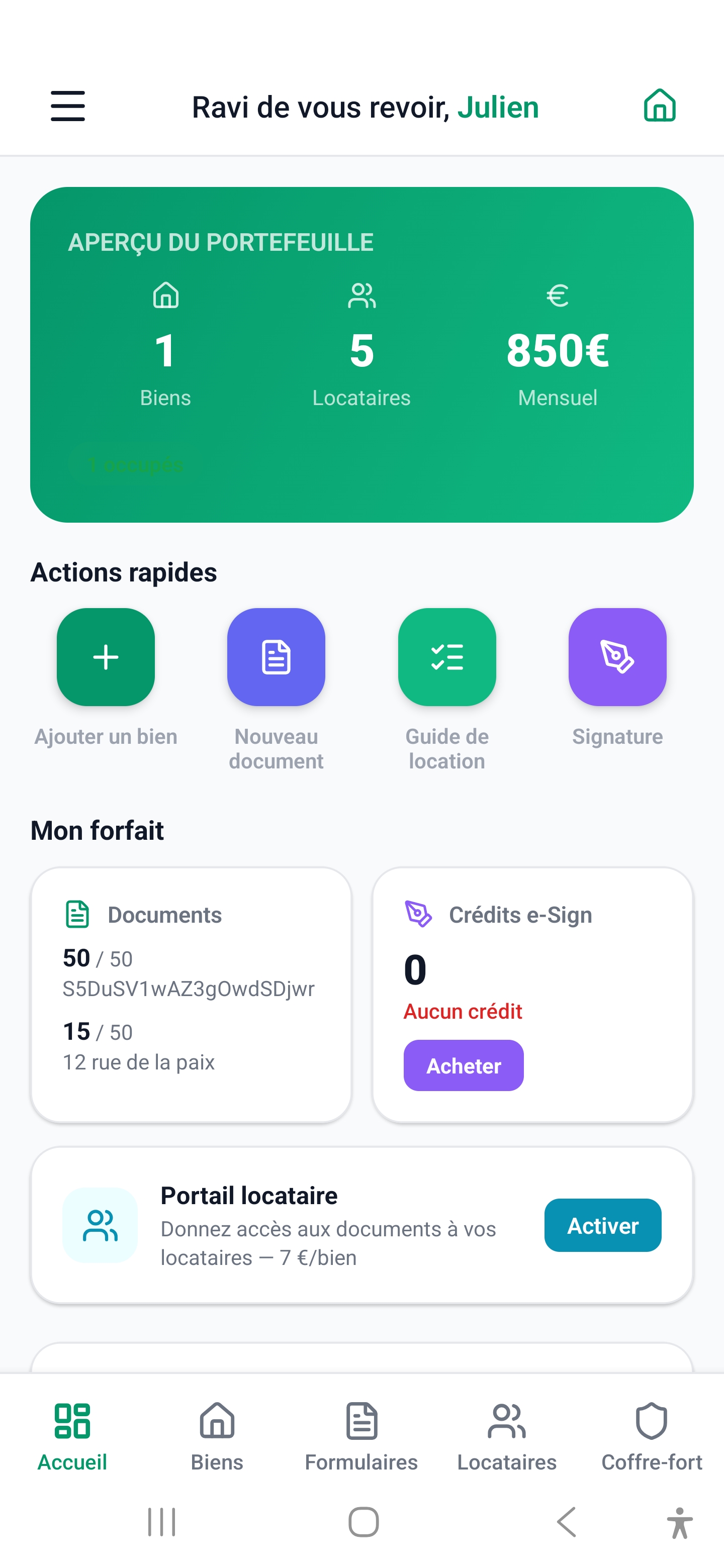
Declaration season is where poor year-round tracking catches up with landlords. Missing one month's quittance can mean an hour of statement-chasing in April; lost PNO certificates can mean a deduction you do not claim. Rent — Lease & Short-Term is a mobile landlord app (Google Play, and also on iOS via the App Store) built specifically around French rental compliance — ALUR-compliant leases, quittances de loyer, digital état des lieux, and — relevant here — year-round tracking of rent received, charges récupérables, non-récupérables, and occupancy rate per property. For tax preparation, that means: - A 2044-ready export of gross rents and deductible charges per property, ready to copy into form 2044 or hand to your expert-comptable. - Automatic charge classification (récupérables vs non-récupérables) so you declare only what is deductible. - Invoice attachments stored alongside the rent ledger, retrievable in April without digging through email. - Occupancy tracking so vacancy periods are clearly visible — important when calculating rental loss or vacancy-related deductions. If you let short-term, the app now also covers meublé-de-tourisme stays — registering stays, generating per-stay guest invoices and taxe-de-séjour records, and surfacing each property's micro-BIC classification (50% classé, 30% non-classé) — so the Airbnb side of your BIC declaration is tracked the same way as the long-term side. It also runs a per-property compliance check — DPE letting-ban status (class G banned since 2025, F from 2028, E from 2034), mandatory diagnostics, SIRET/LMNP, and short-term registration and taxe de séjour — alongside maintenance-deadline tracking (boiler service, chimney sweep, heat-pump/AC, gas and electrical checks, septic tank) with email reminders, so a lapsed obligation never becomes a decency dispute. The same check is available free, no account, with the compliance checker. The pricing is one membership: €6 a month or €59 a year, renewed automatically, cancel any time from your account. Rent receipts (quittances) are free on every account — up to 20 per month, no card required. The first property is also free, with 10 documents included and no card required; after that, the AdminLanding membership adds more properties (up to 10), automated monthly sending of your quittances and the full 23-document set. You can cancel any time from your account, which matters for a tool used mostly twice a year (at lease signing and at tax time). If you prefer a browser-based workflow, the AdminLanding tax-filing toolkit covers the same workflow from the web.
Conclusion: The 2026 filing season is compressed: online opens on 9 April, paper closes on 19 May, and department-banded online deadlines run to 4 June. For individual landlords, the leverage sits in choosing the right regime (micro-foncier vs régime réel for unfurnished, micro-BIC vs régime réel simplifié for furnished), getting déficit foncier and energy-renovation interactions right, and treating the higher 18.6% CSG on furnished income (17.2% kept on foncier) as a planning input rather than a surprise in August. Keep your invoices, run the numbers both ways before clicking submit, and escalate to an expert-comptable when complexity crosses your comfort line. If you want to carry less of the year-round tracking burden, the Rent app, or on iOS via the App Store, does exactly that — rent, charges, occupancy, and a 2044-ready export when April comes around.
Frequently asked questions
Should I choose micro-foncier or régime réel?
Choose régime réel when deductible charges exceed roughly 30% of gross rents — typical after significant works, with a recent loan, or with high non-recoverable copropriety charges. Choose micro-foncier for simplicity when charges are low. Remember that opting into régime réel below the €15,000 threshold commits you for three years.
Can I deduct renovation works from my rental income?
Yes, under régime réel, but only repair, maintenance and improvement works — not construction, reconstruction or extension. Keep every invoice and RGE certification for at least three years. Deduct only the amount paid out of pocket: any MaPrimeRénov' or CEE grant received reduces the deductible base by the amount of the grant.
Is MaPrimeRénov' subsidy considered taxable income?
No. MaPrimeRénov' grants are explicitly excluded from taxable income under CGI article 81. You do not declare them as rental income, and you do not add them back to anything. You simply deduct your net out-of-pocket works cost under régime réel.
What is déficit foncier and how does it work?
When deductible charges exceed rental income under régime réel, the resulting loss (déficit foncier) is deductible from your global taxable income up to €10,700 per year — or €21,400 per year for works that improve the property's DPE class (measure extended for 2026). Any balance rolls forward against future rental income for up to 10 years. Loan interest is excluded from the global-income offset.
Do I need an expert-comptable for LMNP?
For LMNP micro-BIC (below €77,700 gross for 2025 income — €83,600 from 2026 income —, 50% automatic abatement, box 5NI, ex-5ND), no — it is a box on form 2042-C PRO. For LMNP régime réel simplifié, yes in practice — the liasse 2031 + 2033 and the amortisation schedule are technical, and the expert-comptable cost (typically €300–€800/year) is itself deductible.
What happens if I don't declare my rental income?
Non-declaration triggers penalties: 10% standard, 40% for bad-faith, 80% for fraud or abusive arrangements — plus late-payment interest at 0.2% per month. The prescription period is three years, extended to ten in cases of concealed activity. Voluntary regularisation before detection typically limits penalties to the 10% standard rate and interest.
How do social contributions affect rental income in 2026?
In 2026, prélèvements sociaux rise to 18.6% (from 17.2%) on furnished rental income: the CSG increase in the 2026 LFSS applies to net LMNP/BIC income from 2025 income onwards, but expressly excludes unfurnished revenus fonciers and real-estate capital gains, which stay at 17.2%. On €10,000 of net furnished profit, the increase is about €140 more per year. EEA/Swiss residents affiliated to a non-French social security remain exempt from CSG/CRDS but still pay the 7.5% prélèvement de solidarité.
About the author:
Julien Maurice is the founder of AdminLanding and writes the editorial guides on GreenDailyFix covering French renovation aid, energy policy, and the administrative side of the energy transition. Contact: [email protected]
Related posts

DPE Energy Ratings and Your French Rental: The 2026 Letting Bans, Explained
By mid-2026, a French home's DPE letter is no longer a detail on the listing — it decides whether the home may legally be rented at all. Class G has been banned from new lettings since January 2025, F and G rents are frozen, and the loi Le Meur has now closed the short-term escape route by attaching an energy floor to tourist lets too. If you own (or rent) a lettable home in France, this is the July 2026 state of play: what is already banned, what gets banned next, and what an owner of an F or G home can realistically still do.

Renting an Energy Sieve? Your Rights in 2026: Rent Freeze, DPE G Ban, and How Fast You Can Leave
A flat that never gets warm, radiators running flat out, and an electricity bill that hurts more than the rent: living in a passoire thermique (energy sieve) is a daily tax on comfort. But in 2026 the law is firmly on the tenant's side — twice. If you stay, the rent of an F- or G-rated home is frozen and class G has been banned from new leases since 2025. If you decide to leave, the notice rules (préavis) are more favourable than most people think — often 1 month instead of 3 — provided you claim the reduction correctly, send the letter the right way and count the dates the way the law does. This guide covers both halves: your rights while you stay, and the exact mechanics of leaving, including the zone tendue subtlety that most websites get wrong.

Meublé de tourisme: DPE and energy rules in 2026 (loi Le Meur)
If you let a property short-term in France, 2026 is the year energy performance catches up with you. The loi n°2024-1039 du 19 novembre 2024 — the loi Le Meur — pulls meublés de tourisme (furnished tourist rentals) into the same décence énergétique logic that already governs long-term lets. In communes that regulate change of use, a DPE now conditions the right to rent; class F and G properties are being pushed out; and from 1 January 2034 every tourist let that is not the owner's principal residence must reach class D. On top of that, registration has gone national — the State teleservice is in force since 20 May 2026 — and the taxe de séjour still applies. This guide sets out exactly what the law requires, the dates that matter, which properties are exempt, and how to plan renovations before a deadline — or a fine — forces your hand.
Éco-PTZ for landlords: financing a rental renovation at zero interest in 2026
For a French landlord, a rental rated F or G on the DPE is now a countdown, not just a comfort problem. From 1 January 2025 the most energy-hungry homes can no longer legally be rented, and F-rated flats follow in 2028. Renovating is unavoidable — the real question is how to pay for it without draining your cash. This is where the éco-prêt à taux zéro (éco-PTZ) earns its place: a state-backed, interest-free loan of up to €50,000 over 20 years, open to landlords, with no income condition. This guide walks through the 2026 ceilings, the eligible works and the RGE rule, how the éco-PTZ stacks with MaPrimeRénov and CEE on the same works, the prêt avance rénovation variant, and the tie-in with the déficit foncier and the décence énergétique deadlines. Figures are drawn from service-public.gouv.fr and France Rénov; treat this as information, not personalised advice, and confirm each figure at the source before you sign.