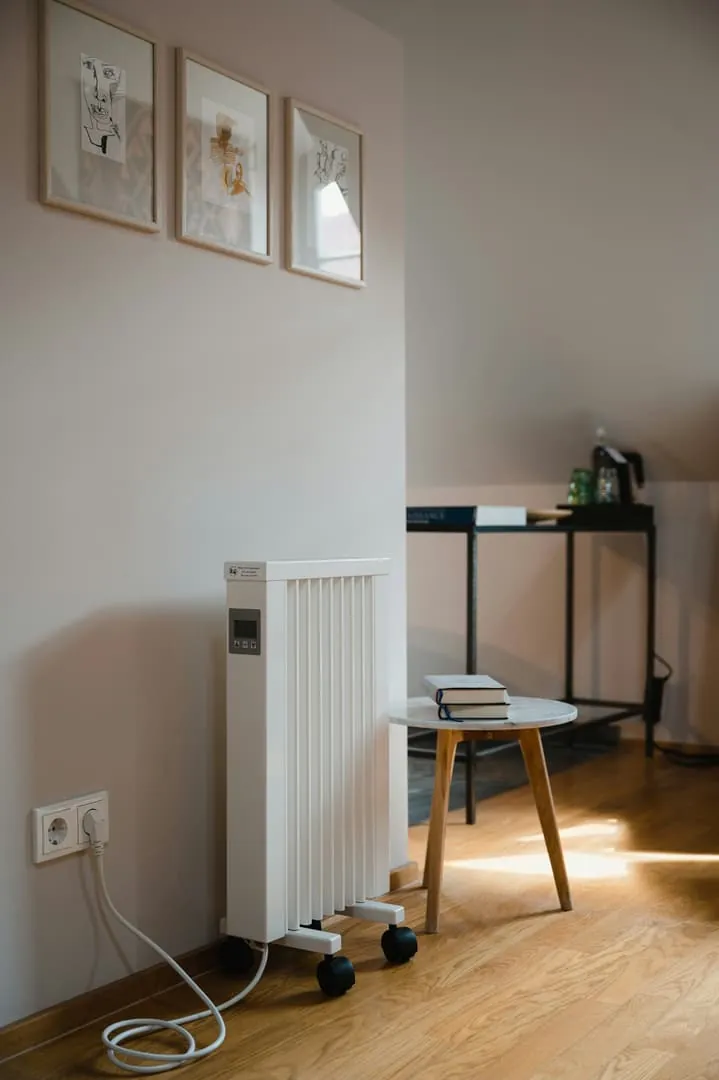
Space heaters in October: choosing the most cost-effective option
October evenings cool down quickly. Before turning on central heating across the whole house, a portable space heater can be the right answer for a single room — saving on full-house heating that's not yet needed. But not all heaters are equal: at €0.1940/kWh on the 2026 Tarif Bleu (base option), running a 2 kW convector for 4 hours a day adds €45+ to the monthly bill, while an oil-filled radiator at the same temperature can do the same job for half the cost. Here's how to choose, what 2026 actually looks like for portable electric heating, and the cases where a space heater beats firing up the central system early.
The electric convector
Cheap to buy, it heats quickly but consumes a lot. Good for a small room used occasionally, not for daily use.
The oil-filled radiator
A bit more expensive, it provides gentle heat and stays warm even after being turned off. More economical over time, perfect for a living room or bedroom.
The ceramic heater
Combining efficiency and safety, it offers fast heating with better regulation. A good compromise for those using it several hours.
Conclusion: The best space heater depends on use. For an occasionally-used room, a convector is fine. For daily 4+ hour heating, an oil-filled radiator or ceramic model wins on running cost. For multi-season use, a portable heat pump gives the best COP but costs €600–€1,200 upfront. In all cases, the real lever is limiting usage time — and from mid-November onwards, the central system usually beats any space heater in a French home. Pair your heater choice with our 5 habits to cut heating bills and winter home preparation tips for optimal energy efficiency.
Frequently asked questions
Are space heaters more efficient than central heating?
Per kWh of electricity, no — all resistive electric heaters are ~100% efficient. But heating one room with a 1.5 kW space heater for 3 hours costs less than firing the gas boiler to heat the whole house. The economics flip once you need 3+ rooms heated simultaneously: central heating wins on cost per delivered kWh of useful heat. For a typical French apartment, October-early November = space heater; mid-November onwards = central.
How much does running a 2 kW space heater cost in France?
€0.39/hour at the 2026 Tarif Bleu base rate (€0.1940/kWh), €0.32/hour off-peak (€0.1579/kWh). A typical 4 h/day usage costs ~€47/month at the base rate, ~€38/month off-peak if you can shift to evening/morning bands. Doubles up if you run two units. Switching to off-peak alone saves ~€9/month, before changing the heater type.
Is a fan heater (convector) really worse than oil-filled?
Per kWh, identical efficiency — both are 100%. But fan heaters cycle on/off rapidly to maintain temperature, drying the air and creating cold zones. Oil-filled units retain heat after switching off, smoothing the temperature curve. Subjectively, oil-filled keeps a room comfortable at a lower thermostat setting, which means less running time, which means lower bills. Real-world saving: 15–25%.
What's the safest space heater for an apartment?
Modern oil-filled radiators are the safest — no exposed element, automatic tip-over cutoff, low surface temperature. Ceramic models with overheat protection are also safe. Avoid old halogen and quartz heaters with exposed elements (fire risk near curtains and pets). All EU-CE-marked heaters sold in France since 2018 must have tip-over and overheat cutoffs by law.
Can I claim subsidies for replacing my heating with electric radiators?
MaPrimeRénov' does not fund portable space heaters. It does fund permanent installations of radiateurs à inertie under the Parcours Accompagné, but only when bundled with insulation work — never as a standalone change. The CEE bonus (Certificats d'Économies d'Énergie) is more flexible for some replacements: check on calculeo.fr or directly with EDF Bleu Ciel before purchase.
About the author:
Julien Maurice is the founder of AdminLanding and writes the editorial guides on GreenDailyFix covering French renovation aid, energy policy, and the administrative side of the energy transition. Contact: [email protected]
Related posts
Most People Aren’t Failing at Sustainable Living — They’re Just Optimising the Wrong Things
If sustainable living feels harder than it should, there’s a reason — and it has nothing to do with laziness or lack of care. In 2026, many people aren’t doing too little for the planet. They’re simply spending their energy on choices that barely move the needle.
If You Want to Live More Sustainably in 2026, Stop Doing More — Start Choosing What to Ignore
After years of advice telling us to optimise everything, many people reach the same conclusion: sustainable living feels like constant self-surveillance. In 2026, the most effective green shift is not about adding new rules, but about consciously deciding what no longer deserves your energy.
Why Sustainable Living Feels Exhausting - And How to Build a Green Life You Can Actually Maintain
Many people do not quit sustainable living because they do not care. They quit because it is exhausting. Too many rules. Too many contradictions. Too much pressure to do everything right, all the time. In 2026, this quiet fatigue has a name - and it is one of the biggest obstacles to real environmental progress.

Your Laundry Might Be Polluting More Than Your Car: The Microplastic Problem at Home
Every time you wash your clothes, thousands of microscopic plastic fibres are released into water systems. In 2026, scientists agree: laundry is one of the largest sources of microplastic pollution — and it happens quietly, at home.