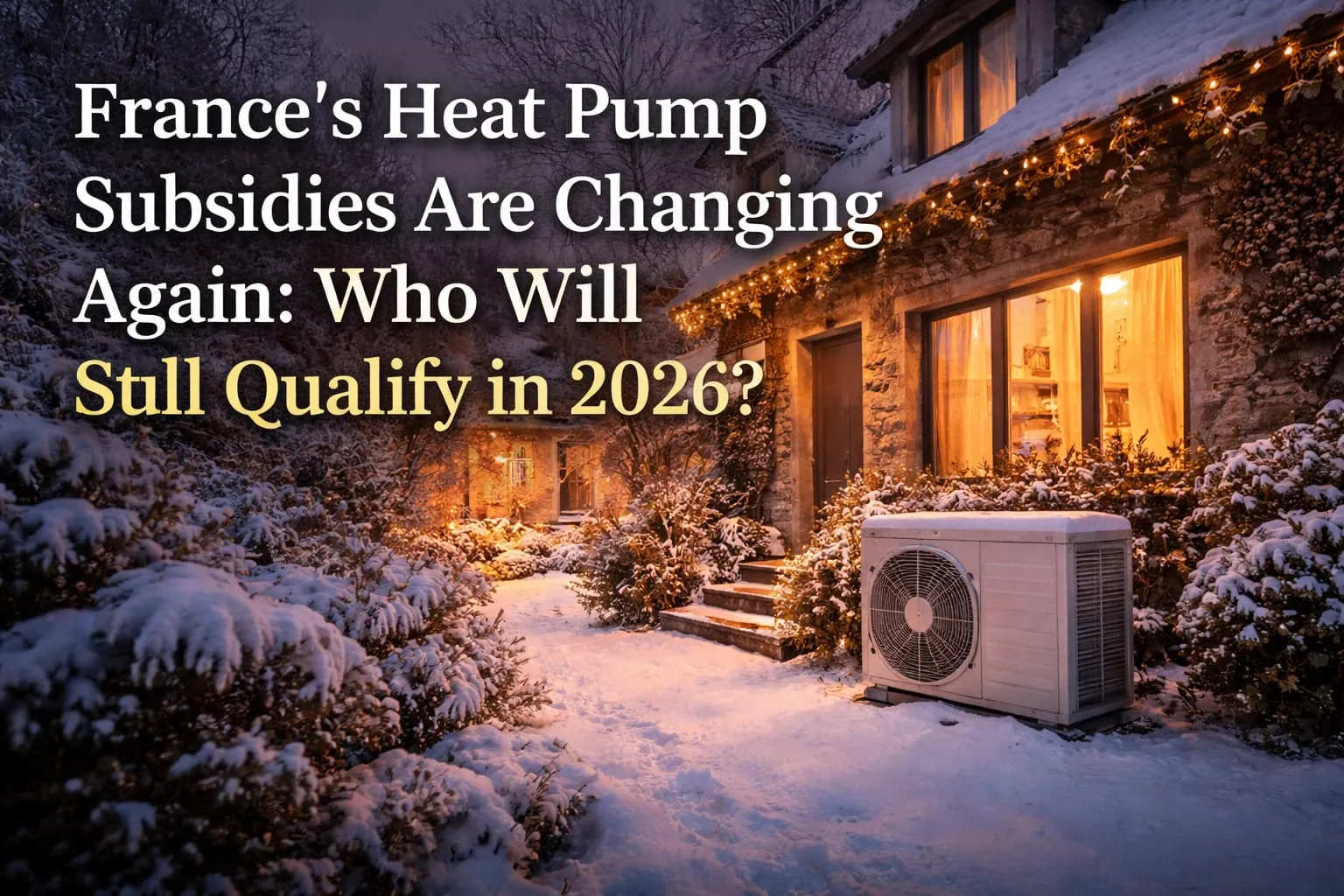
France's Heat Pump Subsidies Are Changing Again: Who Will Still Qualify in 2026?
> Verified 2026-05-26 — figures, eligibility windows and DPE thresholds in this article were re-checked against `maprimerenov.gouv.fr` and `service-public.fr` as of late May 2026. Subsidy rates can change without notice — confirm the current value with the source before filing a claim. For many French households, heat pump subsidies have become the cornerstone of the energy transition. But behind the reassuring headlines, the rules are quietly shifting again. As France prepares its 2026 renovation framework, some households will receive more support — while others may lose access altogether. Understanding who still qualifies is now essential.
1. From mass deployment to targeted performance
France's heat pump policy has entered a new phase. After years of mass incentives designed to accelerate adoption, the government is now tightening eligibility to focus on efficiency and long-term impact.
The objective is clear: stop financing poorly prepared installations and redirect public money toward homes where heat pumps actually reduce energy demand. For real costs, wait times and installer recommendations, our main heat pump France hub covers the full picture.
If you have followed France's earlier measures — from the 2025 heat pump subsidies to the broader renovation reform for 2026 — this new tightening is less a surprise than the next logical step.
2. Why the rules are changing
Three forces are driving the reform. First, budget pressure: heat pump subsidies represented billions in public spending between 2021 and 2025. Second, performance concerns: many installations failed to deliver expected savings because they were installed in homes with poor insulation and limited airflow. Third, EU alignment: France must meet stricter energy efficiency targets by 2030.
At EU level, initiatives such as the eco-renovation wave and the renovation passport push countries to link subsidies more closely to actual performance, not just technology installed.
3. Who will still qualify in 2026
Low-income households remain the main beneficiaries. For the lowest-income brackets supported by agencies such as CAF and the National Housing Agency (Anah), grants are expected to remain significant, provided projects are well designed and integrated into a broader renovation plan.
Rural homes also receive special attention because alternatives to electric heating or fuel oil are limited. In many villages, a properly sized heat pump combined with basic insulation may still be one of the most effective ways to cut bills and emissions.
Apartments in collective buildings are slowly catching up. Redesigned grants will increasingly support shared systems or coordinated renovations at the building level rather than isolated units. The message is clear: no more heat pumps in badly coordinated co-ownerships without a global plan.
Middle-income homeowners face the greatest uncertainty. They will not be excluded, but aid will increasingly depend on completing insulation first and demonstrating a minimum energy gain. Landlords, meanwhile, will need to renovate or risk losing rental eligibility under tighter energy performance rules — a trend already visible in the heat pump market outlook for 2026.
4. What changes in practice
Subsidies will become more explicitly conditional on measured or modelled energy gains. Heat pumps installed in poorly insulated homes will no longer qualify for full support and, in some cases, may lose eligibility altogether.
In practice, this means pre-renovation audits will matter more than ever. Tools similar to the EU renovation passport will help structure multi-step plans: first insulation, then ventilation, then heating systems.
Hybrid systems that combine a heat pump with an existing boiler may continue to receive transitional aid, especially in colder regions or homes with complex layouts. However, these support schemes are likely to be time limited and tied to clear performance conditions.
5. What homeowners should do now
If you are considering a heat pump between now and 2026, the safest strategy is to take a structured approach rather than rush into installation. A pragmatic roadmap usually looks like this:
- check your current DPE rating and ask for a detailed report on heat loss
- prioritise insulation and airtightness where the impact is highest
- plan ventilation upgrades in parallel, especially in older homes
- only size and choose a heat pump once these steps are defined
This approach may feel slower, but it aligns better with subsidy rules and often reduces the pump size you need. Articles such as Heat pump or full renovation first? and Winter heating hacks without renovation can help you design an intelligent sequence rather than a one-shot gamble.
6. Why this matters beyond France
Similar shifts are happening across Europe. Germany, Italy and Spain are all moving toward performance-based subsidies and stronger renovation obligations for the worst-performing homes.
France is no longer an exception; it is aligning with a continental trend in which subsidies, regulations and long-term climate goals converge. The 2026 energy rules for European homeowners and the broader eco-renovation plan show how comfort, emissions and housing quality are being treated as a single package rather than isolated issues.
7. The bigger picture for energy renovation
This reform marks a transition from quantity to quality. The era of installing heat pumps at any cost is ending. What replaces it is a more selective, but potentially more effective, system in which insulation, ventilation and heating design are treated as one project.
For households, this can be good news if it nudges projects toward durable comfort instead of quick fixes. Combined with smart controls, like those explored in smart thermostat guides, a well-designed heat pump in an insulated home still offers some of the strongest long-term savings available.
Frequently Asked Questions
Will heat pump subsidies disappear in 2026?
No, but access will be more selective and performance-based, with a stronger focus on well-insulated homes and measurable energy gains.
Are middle-income households excluded?
No, but insulation and a coherent renovation plan will increasingly be required first, especially in regions where public budgets are under pressure.
Conclusion: France's heat pump subsidies are not ending — they are evolving. The message for households is simple: prepare early, renovate smartly and think long term. Those who adapt their projects to the new rules will still benefit, often with more comfortable and resilient homes as a result.
Frequently asked questions
What changed in MaPrimeRenov for 2026 vs 2025?
The 2026 reform tightens income thresholds for the highest subsidy tiers, requires grouped renovations for maximum grants, and mandates RGE-certified installers with stricter verification.
How do I check if I still qualify for heat pump subsidies in 2026?
Check your eligibility on the official MaPrimeRenov simulator at maprimerenov.gouv.fr using your household tax reference income from your latest tax notice. Income thresholds vary by household size and location.
Can I appeal if my MaPrimeRenov application is rejected?
Yes, you can submit a formal recours gracieux to ANAH within 2 months of the rejection decision. Include any missing documents and a written explanation. If the appeal fails, you can escalate to the administrative tribunal.
Who lost eligibility for heat pump subsidies in 2026?
Higher-income households now receive significantly reduced grants for single-measure installations. Properties that already have a DPE rating of C or better are no longer eligible for heat pump subsidies unless part of a grouped renovation.
About the author:
Julien Maurice is the founder of AdminLanding and writes the editorial guides on GreenDailyFix covering French renovation aid, energy policy, and the administrative side of the energy transition. Contact: [email protected]
Related posts
The Winter Home Problem Nobody Talks About: Humidity, Mould, and the Air You’re Breathing
Every winter, we seal our homes to keep warmth in — and trap something else inside. Humidity rises, air stagnates, and invisible pollutants accumulate. In 2026, indoor air quality is becoming one of the most overlooked health issues in European homes.

From Optimisation to Protection: Why European Homes Are Redefining Energy Strategy in 2026
For years, energy advice focused on optimisation: better efficiency, higher performance, maximum savings. In 2026, European households are quietly changing priorities. The new goal is not perfection - it is protection.

The Illusion of Energy Stability: Why Europe's 2026 Calm Is Costing Households More Than They Think
For the first time in years, Europe entered winter without an energy shock. No dramatic price surge. No emergency headlines. And yet, something more dangerous is happening quietly: households are mistaking stability for safety.

Europe’s Winter Wake-Up Call: The Hidden Energy Decisions Millions of Homes Will Regret Delaying in 2026
This winter, Europe didn’t freeze — but something else happened quietly. Millions of households realized that energy problems no longer arrive as shocks. They arrive as slow, expensive regrets. Winter 2026 isn’t about panic. It’s about the cost of waiting.